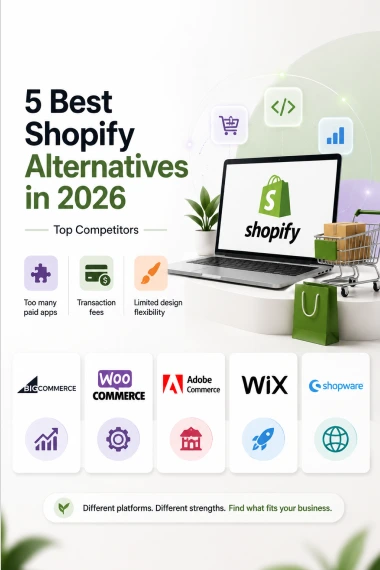
Choosing the right platform for your business comes down to more than price. Merchants exploring a Shopify alternative in 2026 are usually reacting to three recurring frustrations: heavy reliance on paid apps to get basic functionality, transaction fees on external payment gateways, and limited native design flexibility inside Shopify’s templated structure.
For straightforward retail stores, several ecommerce alternatives to Shopify solve these problems well. But for a specific set of sellers, the picture is more complicated, and that’s what most “best Shopify alternatives” roundups miss entirely.
What Are the Best Shopify Alternatives in 2026?

1. BigCommerce. A strong SaaS competitor for scaling brands, BigCommerce eliminates platform transaction fees and ships with advanced B2B and multi-storefront tools out of the box, reducing the need for a bloated app stack.
2. WooCommerce. The go-to pick among shopify alternatives for small business owners who want full data ownership. As a free WordPress plugin, it gives complete code access, though it requires self-managed hosting and developer comfort.
3. Adobe Commerce (Magento). An enterprise-grade option built for massive catalogs and heavily customized setups within the Adobe ecosystem, best suited to larger technical teams.
4. Wix. The entry-level challenger among Shopify competitors, using drag-and-drop tools and emerging AI site-building features to help solopreneurs launch fast without a developer.
5. Shopware. An API-first, open-source platform favored by large international European brands that need strong native B2B functionality and independent hosting control.
Which Shopify Alternative Is Right for You? – A Quick Comparison
| Platform | Best For | Transaction Fees | B2B Tools | Hosting |
| BigCommerce | Scaling DTC & B2B brands | None | Built-in | SaaS |
| WooCommerce | Small businesses, full data control | None | Via plugins | Self-hosted |
| Adobe Commerce | Enterprise, large catalogs | None | Strong | Cloud/self-hosted |
| Wix | Solopreneurs, simple stores | None | Limited | SaaS |
| Shopware | European B2B & mid-market | None | Native | Flexible/self-hosted |
Why Do Promo, Corporate, and POD Sellers Need Something Different?
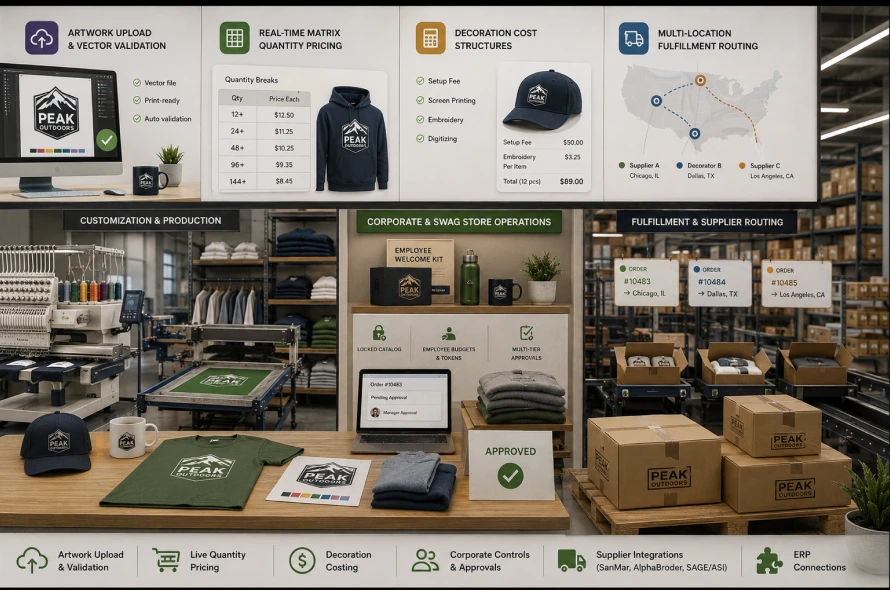
Here’s where most comparison articles stop, and where the real decision-making begins for a specific group of merchants: print-on-demand (POD) shops, corporate company stores, employee swag portals, promotional product businesses, and flash pop-up stores. None of the five platforms above were built around the operational reality these businesses live in every day.
Generic platform comparisons ignore functional gaps that make or break a promo or corporate store, including:
- Artwork upload and vector validation. Customers need to upload logos and artwork that must be automatically checked for print-ready quality, not just accepted as a generic file.
- Real-time matrix quantity pricing. Pricing that changes based on quantity breaks and decoration method, calculated live at checkout.
- Decoration cost structures. Setup fees, screen printing charges, and embroidery costs that stack on top of the base product price.
- Multi-location fulfillment routing. Orders that need to route to different suppliers or decorators based on product and location.
Corporate and swag store deployments add another layer of complexity that consumer-facing platforms rarely address well: locked, company-specific catalogs, allocated employee budgets or token-based gift allowances, multi-tier approval workflows for larger orders, and native integrations with supplier networks like SanMar, AlphaBroder, and SAGE/ASI, alongside enterprise ERP connections.
You might be looking for:
How to Sync SAGE, ASI, and CommonSKU Feeds with Shopify’s Product Matrix
Can These Platforms Handle Artwork, Pricing, and Supplier Integrations?
| Feature | BigCommerce | WooCommerce | Adobe Commerce | Wix | Shopware |
| Artwork/vector validation | Requires app | Requires plugin | Custom dev needed | Not supported | Custom dev needed |
| Matrix quantity pricing | Partial (B2B Edition) | Via plugin | Strong (custom) | Not supported | Strong (native B2B) |
| Decoration cost calculators | Requires app | Requires plugin | Custom dev needed | Not supported | Custom dev needed |
| Supplier network integration (SanMar/AlphaBroder/SAGE) | Not native | Via plugin | Custom dev needed | Not supported | Not native |
| ERP connections | Native | Via plugin | Strong | Not supported | Strong |
The pattern is clear: every alternative on this list needs custom development, third-party apps, or both to handle promo-specific and corporate B2B workflows. None of them solve it natively out of the box.
Which Platform Wins for Your Specific Use Case? Why Shopify is the Best
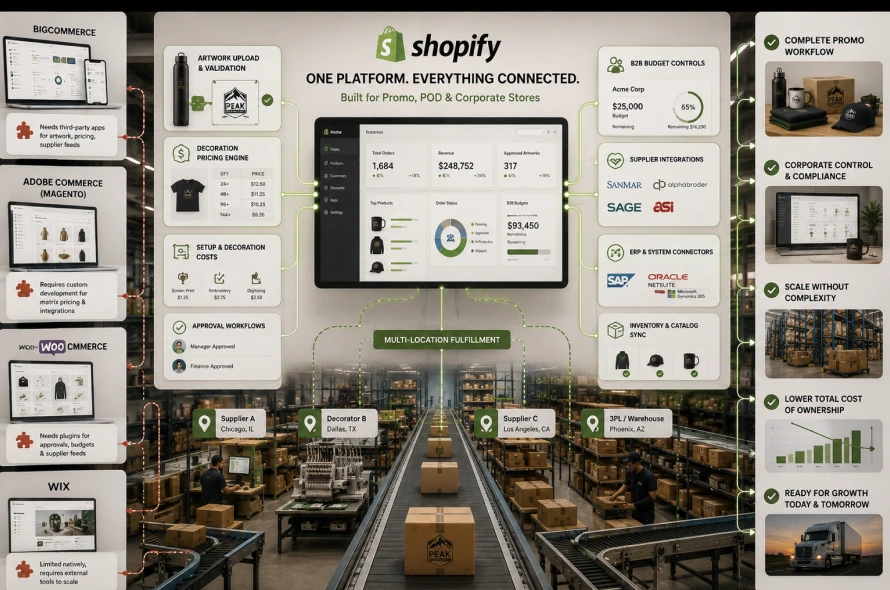
BigCommerce for corporate stores: Strong native ERP and B2B budget controls, but artwork validation and decoration pricing still require third-party apps.
Adobe Commerce for enterprise promo catalogs: Handles massive, highly customized catalogs well, but the custom development needed for matrix pricing and supplier feeds is expensive and slow to deploy.
WooCommerce and Wix for small POD shops: Fast and cheap to launch, but neither offers the approval workflows or supplier integrations that corporate swag programs eventually need as they scale.
How Fast Is B2B Buying Behavior Actually Changing?
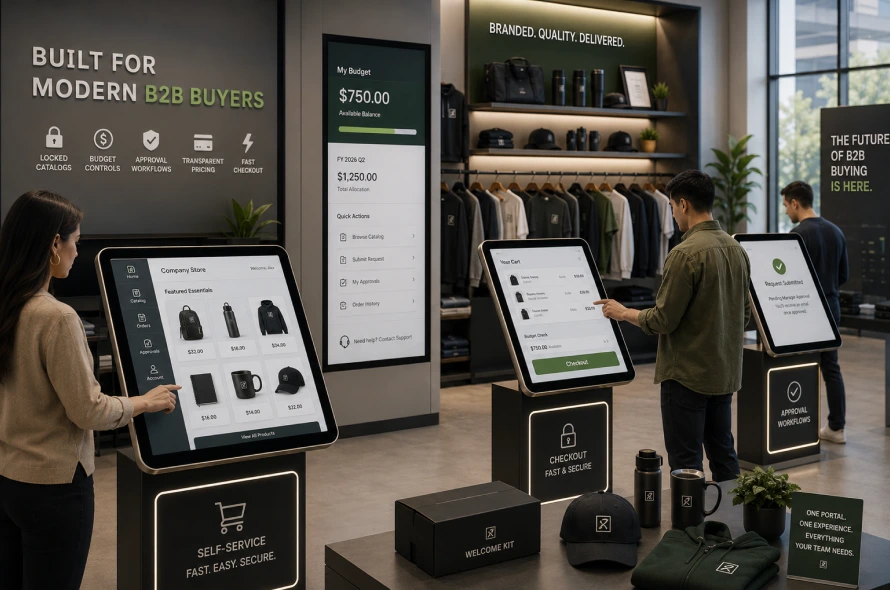
B2B buying behavior is shifting fast: industry research from BigCommerce’s 2026 trend reporting shows that millennials and Gen Z now make up the majority of B2B buyers, and this generation expects self-service portals, transparent pricing, and fast digital checkout, not a phone call to a sales rep. For corporate and promo sellers, that means locked catalogs, budget controls, and approval workflows aren’t optional extras anymore. They’re baseline expectations.
So, Who Is Shopify’s Biggest Competitor?
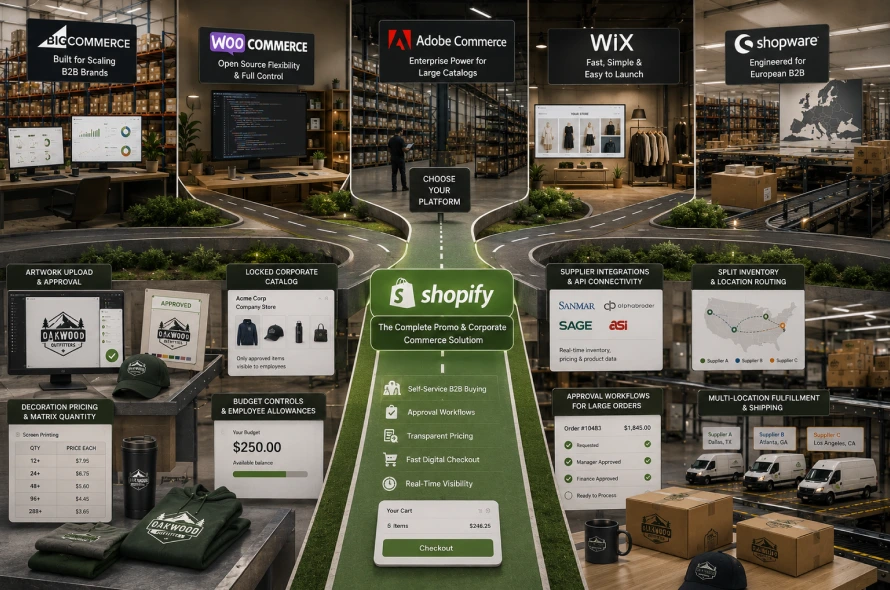
For general retail, the winner depends on your priorities: BigCommerce for scaling B2B brands, WooCommerce for cost and code control, Adobe Commerce for enterprise catalogs, Wix for fast simple launches, and Shopware for European B2B operations.
But for promotional product businesses, corporate swag portals, and POD sellers specifically, switching platforms often isn’t the answer. Shopify, paired with a specialized development partner who understands artwork approval flows, split inventory, and supplier API integrations, frequently outperforms every alternative on this list for this exact use case.
If you’re weighing a full platform switch against a smarter Shopify setup, it’s worth reading our breakdown of Shopify migration costs before deciding, since a well-built Shopify store can often solve these niche problems for less than a custom Adobe Commerce or Shopware build.
FAQs
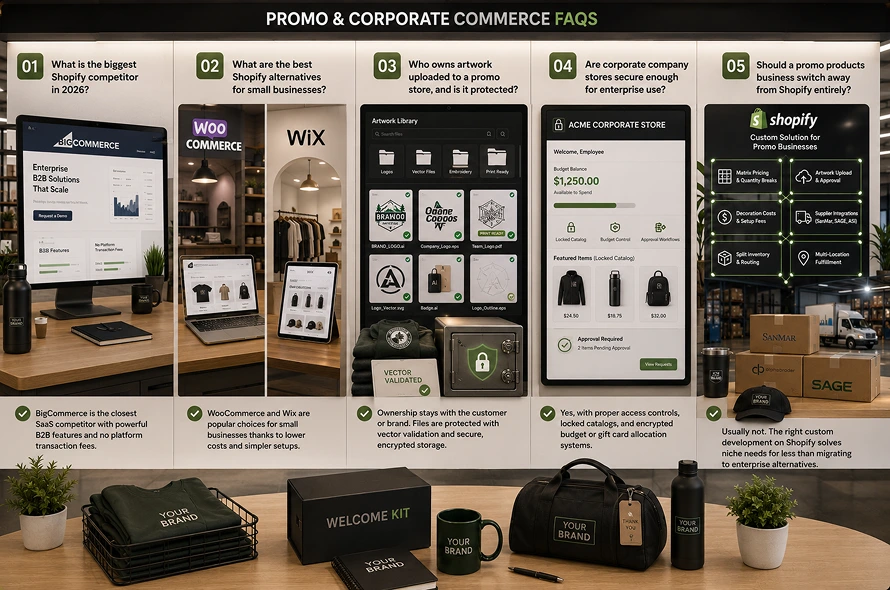
1. What is the biggest Shopify competitor in 2026? BigCommerce is generally considered Shopify’s closest SaaS competitor because of its built-in B2B tools and lack of platform transaction fees, though the “best” competitor depends on your business model.
2. What are the best Shopify alternatives for small businesses? WooCommerce and Wix are the most popular shopify alternatives for small business owners, offering lower upfront costs and simpler setups than enterprise platforms.
3. Who owns artwork uploaded to a promotional products store, and is it protected? Ownership stays with the customer or brand that uploads it, but a properly built platform should include vector validation and secure storage so artwork files aren’t exposed or reused without permission.
4. Are corporate company stores secure enough for enterprise use? Yes, when built with proper access controls, locked catalogs, and encrypted budget or gift-card allocation systems. Security depends more on the implementation than the base platform.
5. Should a promo products business switch away from Shopify entirely? Usually not. Most of the functional gaps in matrix pricing, artwork validation, and supplier integration can be solved with the right custom development on Shopify, often at lower cost than migrating to an enterprise alternative.
Conclusion
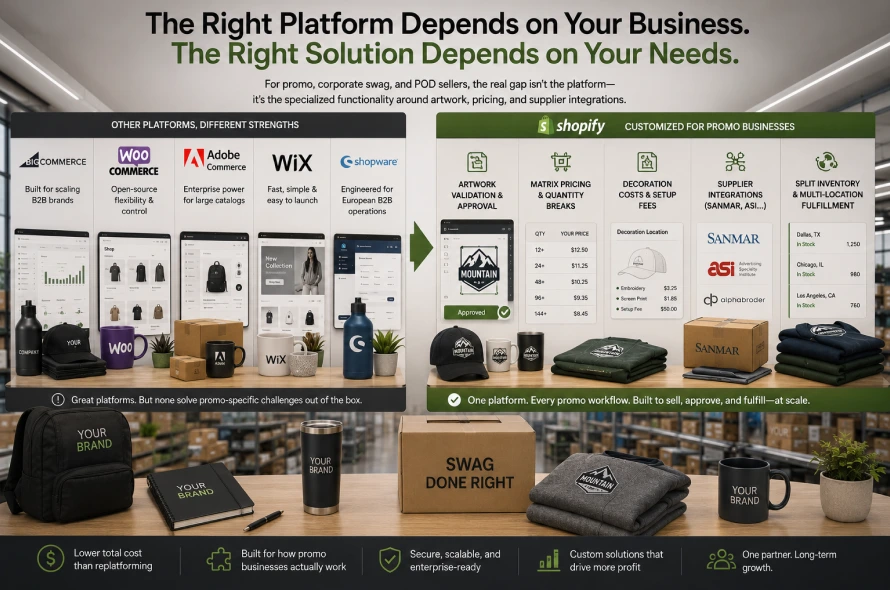
There’s no single Shopify alternative that wins for every business. For standard retail, BigCommerce, WooCommerce, Adobe Commerce, Wix, and Shopware each solve different priorities. But for promotional product sellers, corporate swag portals, and POD shops, the real gap isn’t the platform, it’s the specialized functionality around artwork, pricing, and supplier integrations that none of these alternatives handle natively. Evaluate any platform switch against what a properly customized Shopify build can already do before committing to a costly replatform.