Moving your store to Shopify is one of the biggest technical decisions an ecommerce brand can make. Product data, customer records, order history, SEO rankings, and app integrations all have to survive the move intact. Get it wrong, and you lose sales, rankings, and customer trust in a single weekend. Get it right, and you set your store up for years of smoother growth.
That’s why so many brands search for how to choose a Shopify migration agency before they touch a single line of code. This guide walks through exactly what to look for, what a migration actually involves, what it costs, and how to tell a serious Shopify partner from an agency that’s just winging it.
You might be interested in:
5 Best Shopify Migration Agencies in USA 2026
How Much Does Shopify Migration Cost? (2026 Guide)
What a Shopify Migration Agency Actually Does
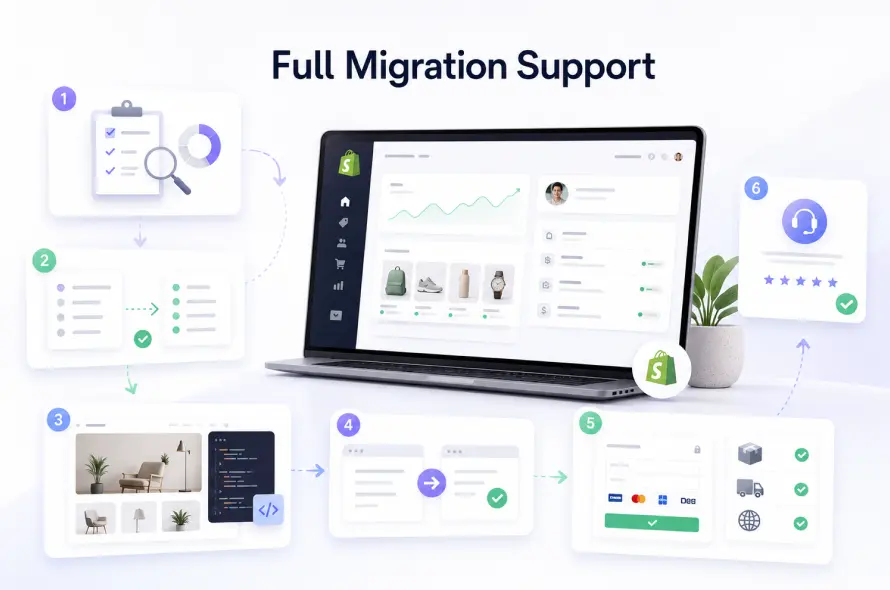
A Shopify migration agency does far more than “move your products over.” A proper Shopify agency for migration handles:
- Auditing your existing store (products, collections, customers, orders, reviews, blog content)
- Mapping that data to Shopify‘s structure without breaking relationships between products, variants, and metafields
- Rebuilding or recreating your theme, custom features, and app functionality on Shopify
- Preserving URL structure and setting up 301 redirects so you don’t lose SEO rankings
- Testing checkout, payment gateways, shipping rules, and tax settings before launch
- Providing post-launch support while your team adjusts to the new platform
If an “agency” only offers to run a data-import app and calls it a day, that’s not a migration partner – that’s a shortcut, and shortcuts are exactly where things break.
Do You Actually Need a Shopify Migration Agency?
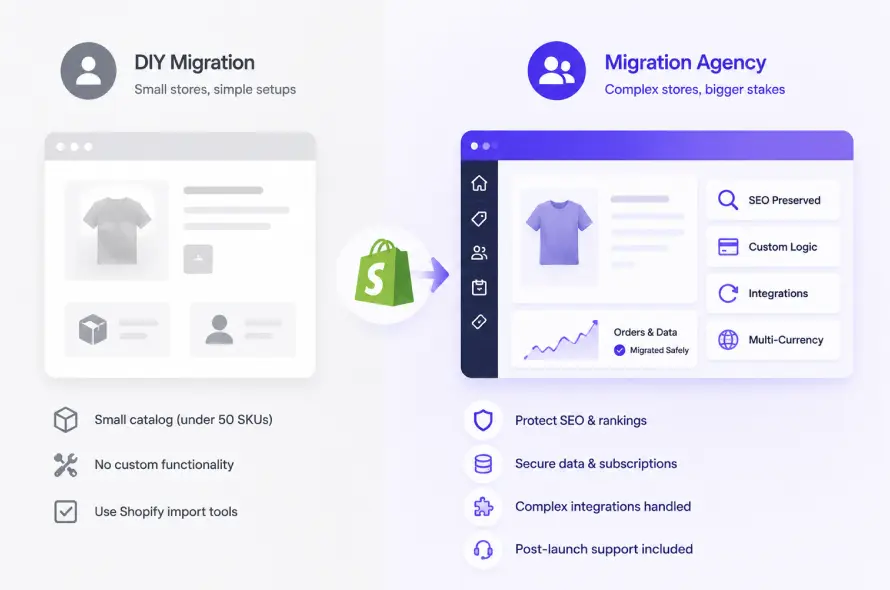
Not every store needs outside help. A very small catalog (under 50 SKUs) with no custom functionality can sometimes be moved in-house using Shopify’s own import tools. But most growing stores need a proper Shopify migration partner because of what’s actually at stake: historical SEO equity, custom checkout logic, subscription data, multi-currency setups, and third-party integrations that don’t map cleanly between platforms.
Agency vs. Freelancer vs. In-House – Which Route Is Right?
| Route | Best for | Risk level |
| In-house | Very small, simple stores with basic catalogs | Low complexity, but high risk if your team lacks Shopify experience |
| Freelancer | Budget-conscious, small-to-mid stores with straightforward needs | Variable quality, limited accountability if something breaks post-launch |
| Shopify migration agency | Mid-to-large stores, custom features, multiple integrations, SEO-heavy sites | Lowest risk – structured process, testing, and support included |
A freelancer might be cheaper upfront, but agencies typically offer QA checklists, dedicated project management, and post-launch support that a solo freelancer usually can’t match. For anything beyond a basic store, a certified Shopify migration agency is the safer investment.
What a Shopify Migration Includes
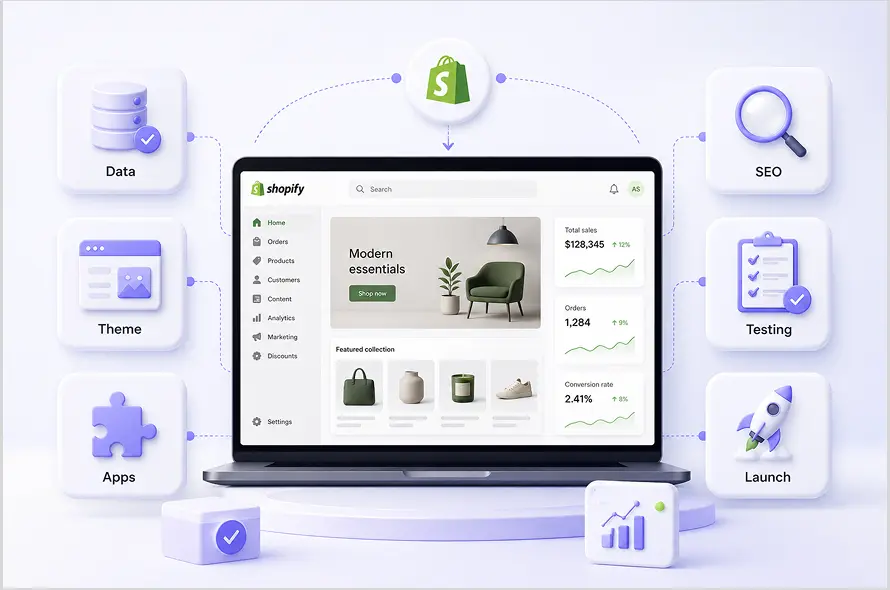
When you hire a Shopify migration partner, the scope usually covers:
- Data migration – products, variants, images, collections, customers, order history, and reviews
- Theme development – a new Shopify theme built to match (or improve) your existing design
- App and integration setup – email marketing, reviews, loyalty, ERP, and payment gateways reconnected
- SEO preservation – redirect mapping, metadata transfer, and structured data setup
- Testing – checkout flows, shipping rates, tax rules, and mobile responsiveness
- Launch and post-launch monitoring – watching for broken links, cart errors, or missing data in the first weeks
When to Hire a Shopify Migration Partner
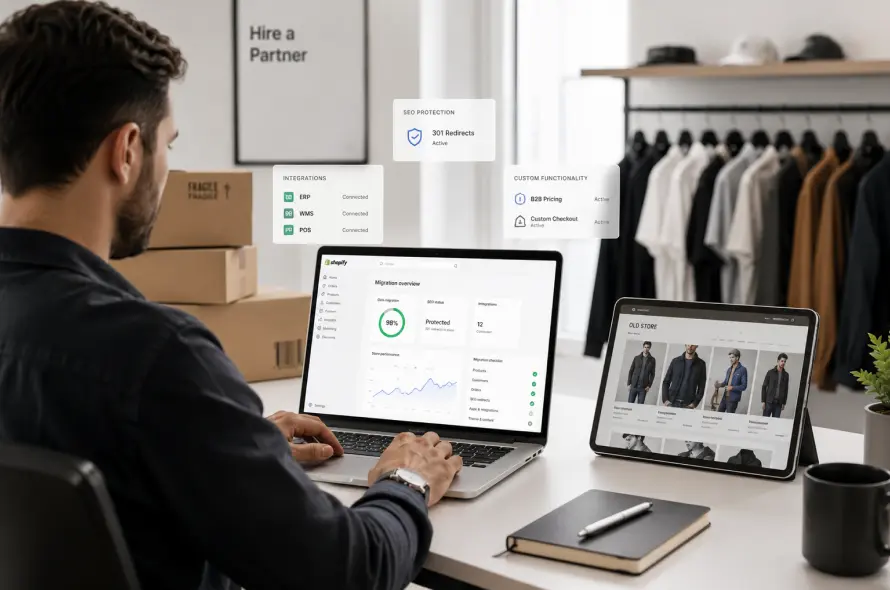
The right time to hire a Shopify migration agency is usually before you commit to a launch date, not after. Common triggers include:
- Your current platform (WooCommerce, Magento, BigCommerce) is limiting growth or costing too much in dev maintenance
- You’re consolidating multiple storefronts (like an Etsy shop and a custom site) into one Shopify store
- You need to move without losing years of accumulated SEO authority
- Your current site has custom functionality that a plug-and-play import tool can’t replicate
Migration Cost and Risk Change With Your Source Platform
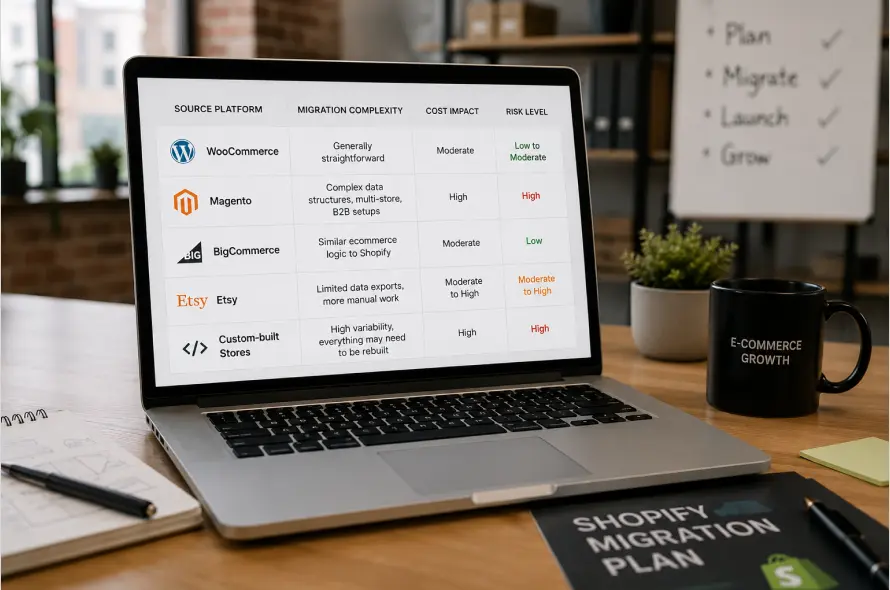
Not all migrations are equal. The platform you’re moving from directly affects both cost and risk:
- WooCommerce – Generally straightforward since it’s WordPress-based, but plugin-dependent features often need custom rebuilding on Shopify.
- Magento – Complex data structures (especially multi-store and B2B setups) make this one of the more involved migrations.
- BigCommerce – Similar underlying ecommerce logic to Shopify, which usually makes this a smoother, lower-risk migration.
- Etsy – Limited data export options mean more manual work to rebuild listings, reviews, and customer history.
- Custom-built stores – Highest variability; everything from database structure to checkout logic may need to be rebuilt from scratch.
Any Shopify migration agency worth hiring should ask detailed questions about your source platform before quoting a price – if they quote you instantly without this, that’s a red flag.
How Much a Shopify Migration Agency Costs
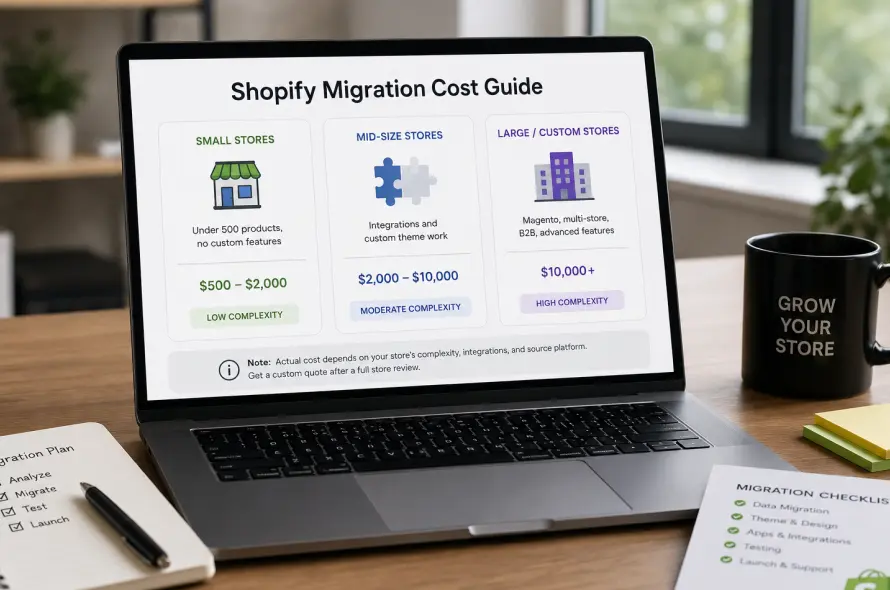
Pricing depends on catalog size, custom features, and source platform, but general ranges look like this:
- Small stores (under 500 products, no custom features): a few hundred to a couple thousand dollars
- Mid-size stores with integrations and custom theme work: a few thousand dollars
- Large or highly custom stores (Magento, multi-store, B2B): can run into five figures
Be cautious of agencies quoting a flat, low price without seeing your store first. Migration cost should reflect actual complexity, not a generic package.
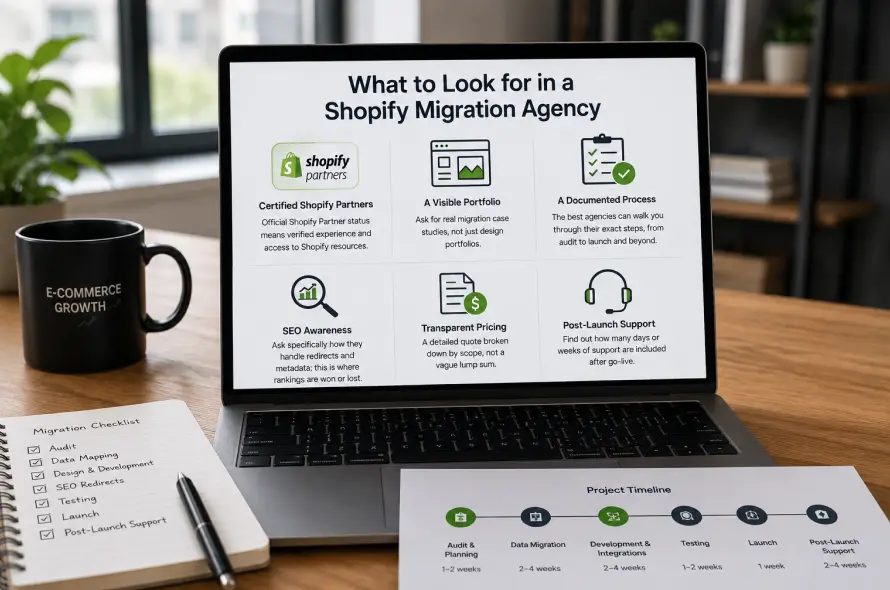
What to Look for in a Shopify Agency

When you’re comparing options, here’s how to evaluate a Shopify migration partner properly:
- Certified Shopify Partners – Official Shopify Partner status means the agency has verified experience and access to Shopify’s own resources and support channels.
- A visible portfolio – Ask for real migration case studies, not just design portfolios.
- A documented process – The best Shopify migration agencies can walk you through their exact steps, from audit to launch to post-launch support.
- SEO awareness – Ask specifically how they handle redirects and metadata; this is where rankings are won or lost.
- Transparent pricing – A detailed quote broken down by scope, not a vague lump sum.
- Post-launch support – Find out how many days or weeks of support are included after go-live.
How to Vet a Shopify Migration Agency
Before signing anything, ask these questions:
- Can you show me a similar migration you’ve completed (same source platform, similar size)?
- How do you handle SEO and URL redirects during the move?
- What’s your QA process before launch?
- What happens if something breaks after launch – is support included?
- Are you a certified Shopify Partner, and can I verify that?
If an agency hesitates on any of these, treat it as a signal to keep looking.
The Best Shopify Migration Agencies in 2026

There’s no single “best” agency for every store – the best Shopify partner for migration is the one whose process, pricing, and communication match your store’s complexity and timeline.
When shortlisting top Shopify migration agencies, prioritize agencies that combine certified Shopify Partner status, a transparent process, real case studies, and dedicated post-launch support rather than the lowest quote you can find.
This is exactly the standard we hold ourselves to at Swishtag. Our team has handled migrations from WooCommerce, Magento, BigCommerce, Etsy, and custom-built stores, with a process built around preserving SEO rankings, testing thoroughly before launch, and staying available after your store goes live.
GET FREE AUDIT
FAQs – How to Choose a Shopify Migration Agency?
What should I look for in a Shopify agency?
Look for certified Shopify Partner status, a documented migration process, real case studies from similar stores, clear SEO handling (redirects and metadata), transparent pricing, and post-launch support.
How do I choose the right Shopify migration partner?
Compare agencies on experience with your specific source platform, their QA and testing process, how they preserve SEO rankings, and whether support continues after launch – not just on price.
What does a Shopify migration agency actually do?
They audit your existing store, migrate products and customer data, rebuild your theme and app integrations, set up redirects to protect SEO, test everything before launch, and monitor the store after go-live.
Do I actually need a Shopify migration agency, or can I do it myself?
Very small, simple stores can sometimes migrate in-house. Stores with custom features, large catalogs, multiple integrations, or significant SEO equity are much safer in the hands of an experienced Shopify migration partner.
How much does a Shopify migration agency cost?
Cost depends on catalog size, customization, and source platform – ranging from a few hundred dollars for small stores to five figures for large, highly custom migrations from platforms like Magento.
How long does a typical Shopify migration take?
Most migrations take anywhere from one to six weeks, depending on catalog size, the number of integrations, and how much custom theme work is involved.
Final Thoughts – How to Choose a Shopify Migration Agency
Choosing the right Shopify migration agency comes down to one thing: finding a partner who treats your data, your SEO, and your launch date with the same seriousness you do. Ask the right questions, check for certified Shopify Partner status, and don’t settle for a vague quote.
If you’re planning a migration and want a team that’s done this before, Swishtag’s migration specialists are happy to walk through your store and give you a clear, honest scope before you commit to anything.