
The promotional products industry is a massive, $25 billion business hiding in plain sight. Every branded pen, custom coffee mug, and corporate hoodie you see at business events or offices was sourced by someone.
The best part? You don’t need to buy expensive screen-printing machines, embroidery setups, or a giant warehouse to make money here. By becoming a promotional products distributor, you act as the strategic middleman. You buy custom goods directly from specialized factories at wholesale trade rates and sell them to corporate clients at retail prices.
If you are a complete beginner looking to start your own low-risk B2B agency, this step-by-step how to become a promotional products distributor guide will take you from zero to your first profitable bulk delivery.
You Might Be Interested in:
SAGE vs ESP vs CommonSKU – Which Order Management Systems for distributors is King?
The Perfect Promotional Product Distributor Workflow
How the Supply Chain Works
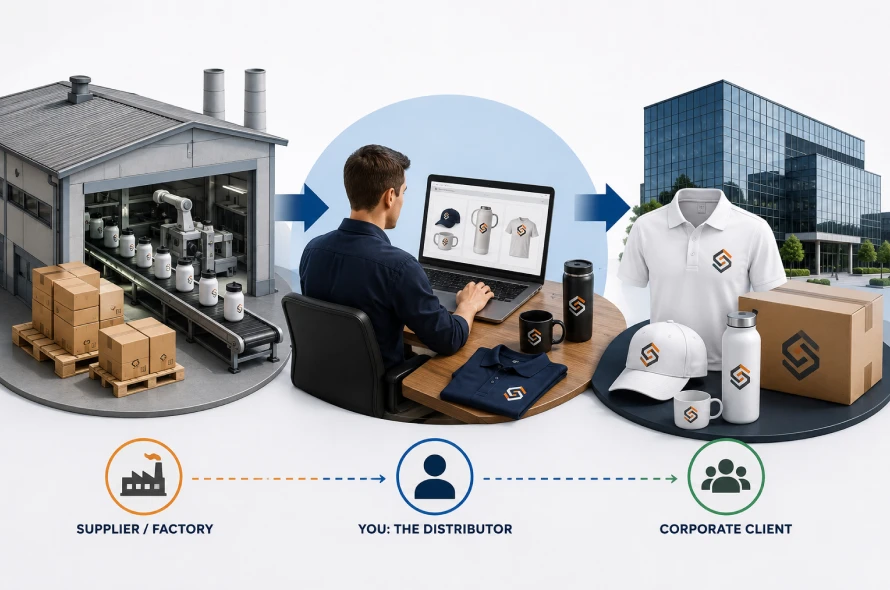
Before you register a business, you need to understand who does what. The industry survives on a strict split between two main players: Suppliers and Distributors.
[Supplier / Factory] ──(Wholesale Price)──> [You: The Distributor] ──(Retail Price)──> [Corporate Client]
The Supplier (The Factory)
Suppliers are the manufacturers who stock thousands of blank items (like water bottles, shirts, and tech gadgets) and handle the actual printing or engraving.
Crucial rule: These factories do not sell directly to the public or regular businesses. They protect their network by routing all sales through distributors.
What is the Promotional Product Distributor (Your Role)
You are the sales arm. You approach businesses, dental clinics, or tech startups, find out what branded items they need for marketing, recommend the right products, and handle the order. You collect the payment from the client upfront, place the order with the supplier at low wholesale pricing, and the supplier ships the finished, branded goods directly to your client.
The Profit Math is Simple:
As a registered distributor, you buy items at a “trade discount” (often 30% to 50% off retail pricing). If a custom water bottle retails for $10, your wholesale cost might be $5. If a corporate client orders 500 bottles, your gross profit on that single order is $2,500.
2. What Do You Need at the Start? (The Entry Requirements)
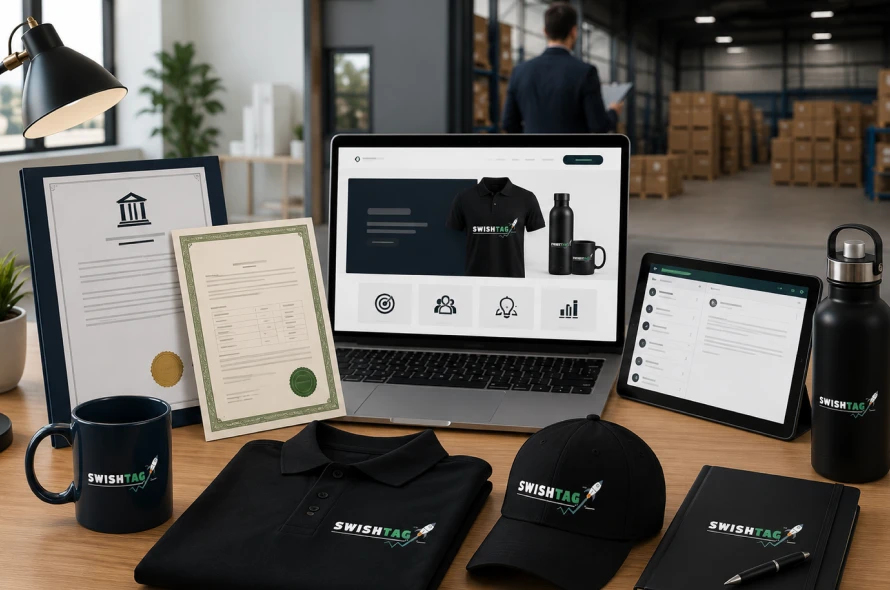
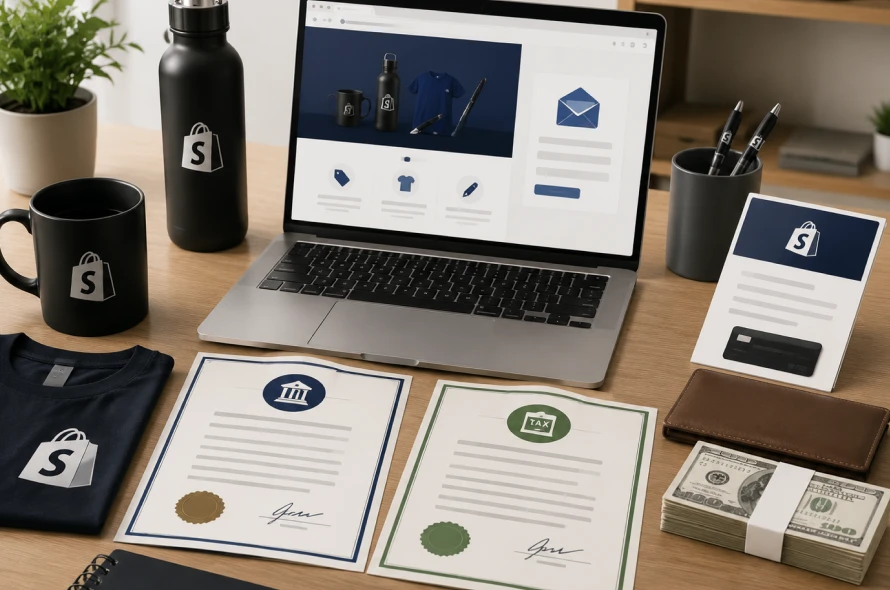
You cannot simply call a wholesale factory and ask for cheap pricing. They will instantly turn you away to protect the industry. To get insider access, you must prove you are a legitimate business entity.
Here is exactly what you need to set up first:
- Legal Business Registration: You must register your business as an LLC or Sole Proprietorship depending on where you live. Factories require official corporate status.
- Sales Tax ID (Resale Certificate): This is the most crucial document. A resale certificate proves to factories that you are buying goods to resell them to an end-user. This exempts you from paying sales tax when buying from the factory, legally shifting the tax burden to your client.
- Professional Email & Basic Website: Do not use a generic Gmail address. You need a dedicated domain name (e.g., sales@yourswagagency.com) and a clean, basic landing page showing that you specialize in corporate branding solutions.
3. The Gatekeepers: Unlocking the Master Networks (ASI, PPAI, and SAGE)
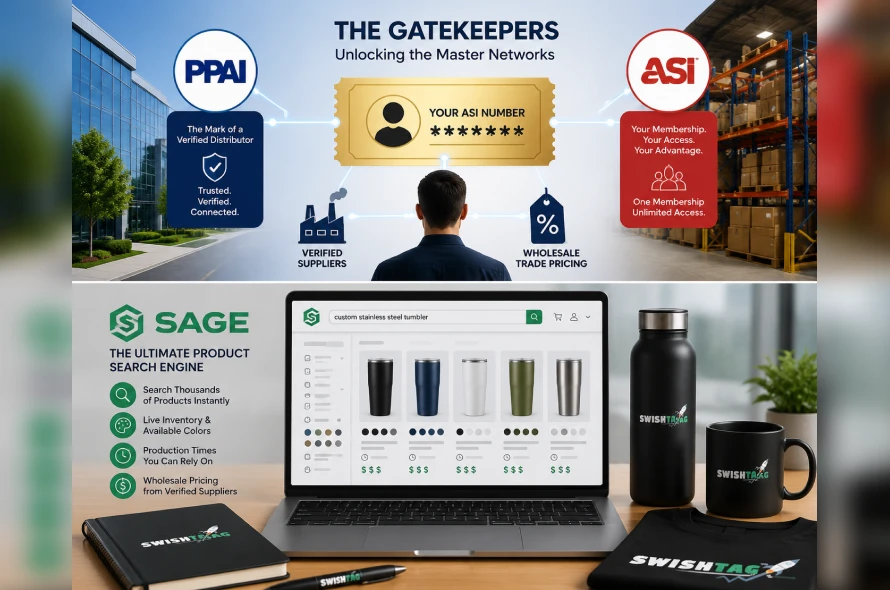
Once your legal paperwork is ready, you need your industry “passport.” The entire industry revolves around major networks that connect verified distributors with verified factories:
- PPAI & ASI: These are the master organizations of the industry. When you join, they issue you a unique membership number (like an ASI Number). This number is your golden ticket. When a supplier asks for your credentials, you give them this number, and they instantly unlock wholesale trade pricing for you.
- SAGE Network: SAGE provides the actual product database software. Think of it as a specialized Google for promo products. Instead of browsing 500 different factory websites, you log into SAGE, type “custom stainless steel tumbler,” and the system shows you live inventory, available colors, production times, and wholesale pricing from thousands of verified factories simultaneously.
4. How Much Money is Required to Start?
How much cash do you actually need to break into this space? Let’s talk about real numbers. You do not need tens of thousands of dollars because you aren’t buying inventory upfront. However, you do need enough starting capital to cover your setup tools.
A Realistic Startup Budget: $1,500 to $2,500
Here is where that money goes:
- Business Registration & Tax IDs: $100 – $300 (depending on your local government fees).
- Domain, Email Setup, & Website Landing Page: $50 – $150.
- Industry Association Subscriptions (ASI/SAGE): $600 – $1,200 annually (Many offer monthly payment plans for beginners).
- Initial Marketing & Emergency Buffer: $500 (For outreach tools or unexpected setup proofs).
The Hidden Fees Beginners Miss (The Cost Traps)
When quoting a client, beginners often calculate the raw item cost and think they are done. That is a quick way to lose money. Every wholesale factory quote includes three hidden variables:
- Setup Charges: Factories charge a flat fee ($40 to $80) to clean printing machines, burn screens, or calibrate lasers for your client’s specific logo. This fee applies whether you order 10 items or 1,000 items.
- Run Charges: If your client wants their logo printed in multiple colors or in multiple locations (e.g., the front and sleeve of a jacket), the supplier will charge an extra fee per item (e.g., $0.50 per additional color).
- Shipping Logistics (Freight): Promo items are heavy. Shipping 500 ceramic mugs or thick hoodies costs a significant amount of money. Always get a freight estimate from the factory before giving a final price to your B2B client.
5. Manual Spreadsheets vs. Software: How to Manage Orders Safely
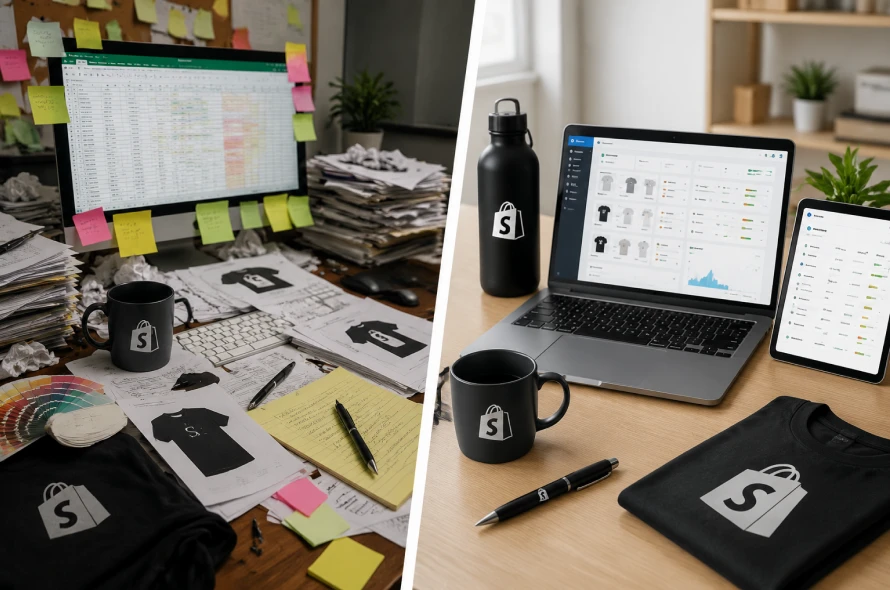
When you start, you might think: “I will just track everything on Excel or Google Sheets.”
If you have 1 client buying 100 t-shirts, a spreadsheet works fine. But if you have 3 or more clients active at the same time, managing them manually becomes dangerous. A single order involves tracking the client’s logo design file, factory stock levels, multiple sizes/colors, setup fees, and strict event deadlines. One small typo on a spreadsheet can ruin a $2,000 order, and that money comes right out of your pocket.
The Tools Professional Distributors Use
To avoid costly mistakes, successful distributors rely on specific tools:
- Product Sourcing (SAGE / ASI ESP+): Costs around $60 – $120/month. This lets you search through millions of items instantly to find the best profit margins.
- Order Management System (like commonsku): Costs around $100 – $150/month. This is an all-in-one software. It lets you send professional quotes to clients, collect their digital signatures for design approvals, and send automated purchase orders straight to the factory.
- Artwork Trackers (like Swishtag AX): These tools automate the review loop between the client and the designer to make sure the logo graphics are perfectly aligned before production begins.
6. Packaging, Fulfillment, and the “Swag Box” Up-sell
Modern corporate clients rarely want loose items tossed into a messy brown box. They want an “unboxing experience.” You can easily double your profit margins by offering custom packaging and assembly (called Kitting and Fulfillment).
The Profit Comparison Matrix
Let’s look at the math for a 50-person corporate onboarding order:
| Expense Item | Standard Order (Loose Items) | Premium Experience (Swag Box) |
| Product Cost (Shirt, Mug, Notebook) | $15.00 | $15.00 |
| Custom Box + Tissue Paper + Sticker | $0.00 | $4.50 |
| Kitting Fee (Labor to pack the box) | $0.00 | $2.00 |
| Total Cost to You | $15.00 | $21.50 |
| Selling Price to Client | $23.00 | $45.00 |
| Net Profit Margin Per Unit | $8.00 (34%) | $23.50 (52%) |
On a small order of 50 boxes, the standard loose-item method makes you $400 in profit. The Custom Swag Box method makes you $1,175 in profit!
Who Packs the Boxes?
You do not have to pack these boxes in your living room.
- Factory Kitting: Many large suppliers will pack the custom boxes for you for a small labor fee.
- 3PL (Third-Party Logistics): You can have all items shipped to a specialized fulfillment warehouse. They will assemble the custom boxes and mail them individually to your client’s remote employees all over the world.
7. How to Hunt Your First Paying B2B Clients
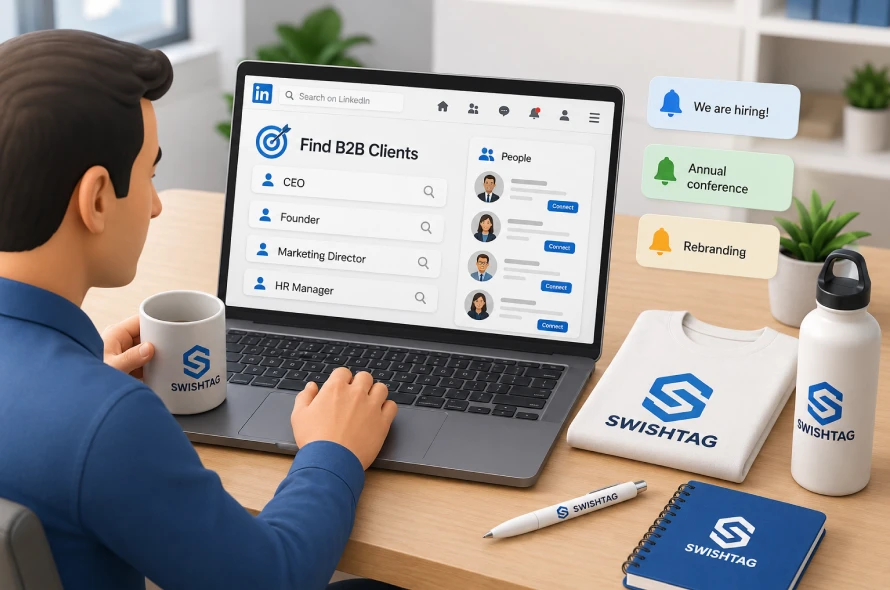
The most important question, “How to find your first paying b2b client?” Mass emailing or spamming random companies has a terrible response rate (usually less than 1%). Instead, you can use a highly targeted approach on LinkedIn.
Here is The Best LinkedIn Target Strategy
The people who buy corporate gifts are usually CEOs, Founders, Marketing Directors, and HR Managers. You can find them instantly by typing specific phrases into the LinkedIn search bar, such as:
Linkedin Search Query: (“Marketing Director” OR “HR Manager” OR “CEO”) AND “Tech Startup”
Watch for “Intent Keywords”
Look for companies posting updates that mention:
- “We are hiring!” (They need New Hire Swag Boxes).
- “Announcing our annual conference…” (They need branded pens, lanyards, and event t-shirts).
- “Unveiling our new logo / rebranding” (They need to replace all their old branded corporate gear).
High-Value Niches for Beginners
Focus on industries that buy promotional products frequently:
- Specialized Medical & Dental Clinics: They need constant patient giveaways (like branded toothbrushes, lip balms, or pens) and staff uniforms. These are great clients because they re-order every single month.
- Real Estate Agencies: Agents constantly buy high-end closing gifts or custom keychains for new homeowners.
8. Two Critical Mistakes to Avoid
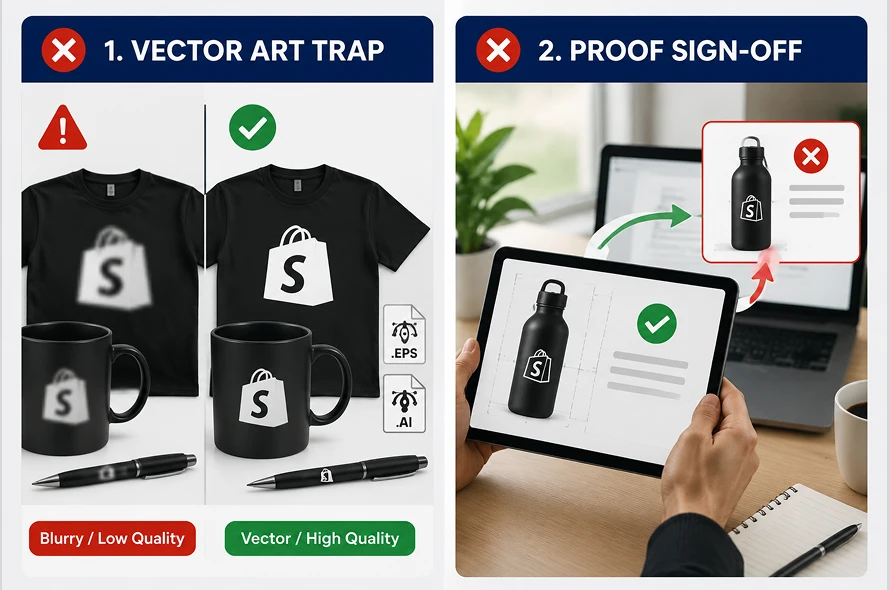
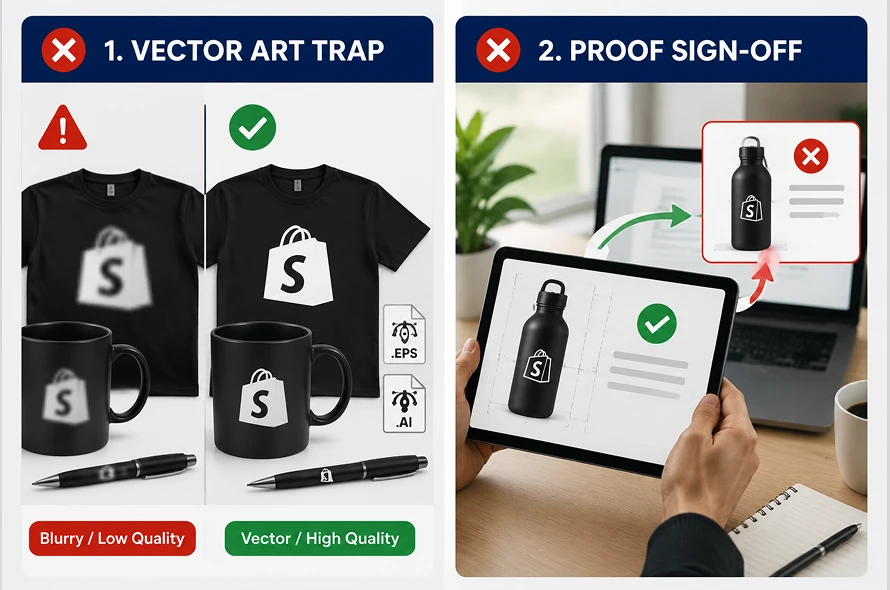
Mistake #1: The Vector Art Trap
Clients will often send you a low-quality, blurry .PNG or .JPG image of their logo and ask you to print it. Never send this to the factory. If you do, the physical print will turn out blurry, and the client will reject the order. Always demand a Vector File (files ending in .EPS, .AI, or high-res vector PDFs). Vector files can be resized perfectly without losing sharpness.
Mistake #2: Skipping the Proof Sign-Off
Before printing your order, the factory will send you a digital image called a “Digital Proof.” This shows exactly where the logo will sit on the product. Never just glance at it and say “looks good.” Email the proof to your client and get them to reply with the exact words “Approved for Production.” If the factory messes up an approved proof, they pay for the mistake. If you approve it without the client’s explicit sign-off and the client hates it, you pay for it.
Ready to Build Your Own Promo Agency?
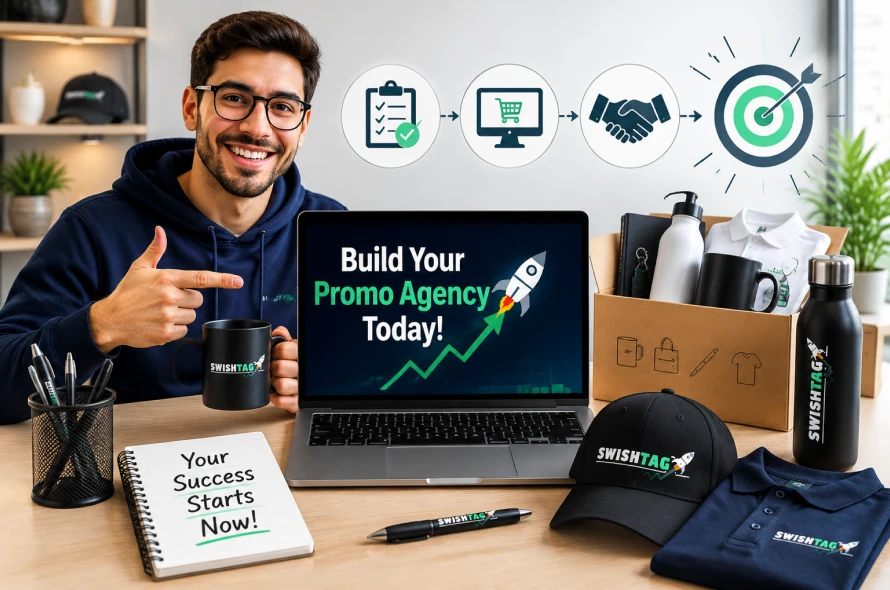
If you are a beginner looking to take your first steps, setting up your legal paperwork, or figuring out which order management system (OMS) works best for your specific niche, I can help you fast-track the process and avoid the expensive mistakes most rookies make.
Need hands-on guidance to set up your workflow, choose your tech stack, or build your B2B client pipeline? [Contact Here] to get started!
Final Words: Just Start Small, Then Automate
Every major promotional agency started exactly where you are standing right now: with a laptop, a business registration certificate, and a desire to help other brands look professional.
Do not let the initial steps overwhelm you. You don’t need to buy a $150/month automated tool on day one. Start with simple, manual Google Sheets for your first client or two. Once the orders begin to repeat, use your profits to invest in a dedicated tech stack like SAGE or commonsku or Custom order management software to automate your operations and scale up.
The market is massive, businesses are always spending money on marketing, and the factories are waiting for you to bring them orders. Take action, secure your industry passport, and build your agency!
Must Read: How to Sync SAGE, ASI, and CommonSKU Feeds with Shopify’s Product Matrix
FAQs
What is a promotional products distributor?
A promotional products distributor is the sales middleman between wholesale suppliers and corporate clients. The distributor helps businesses choose branded products, collects payment from the client, places the order with the supplier at wholesale pricing, and manages the order until delivery.
Do I need printing machines to become a promotional products distributor?
No. You do not need screen-printing machines, embroidery equipment, or a warehouse. Suppliers and factories handle manufacturing, printing, engraving, and fulfillment. Your role is to source the right products, manage the client relationship, and coordinate the order process.
What do I need to start as a promotional products distributor?
To start as a promotional products distributor, you usually need legal business registration, a sales tax ID or resale certificate, a professional business email, a basic website, and access to industry networks such as ASI, PPAI, or SAGE.
How much money is required to start a promotional products distributor business?
A realistic startup budget is usually around $1,500 to $2,500. This can cover business registration, tax documents, domain and email setup, a basic website, industry subscriptions such as ASI or SAGE, and a small marketing or emergency buffer.
How do promotional products distributors make money?
Promotional products distributors make money by buying custom products from suppliers at wholesale trade pricing and selling them to corporate clients at retail pricing. The difference between the supplier cost and the client price becomes the distributor’s gross profit.
What software do promotional products distributors use?
Promotional products distributors commonly use tools such as SAGE, ASI ESP, CommonSKU, Google Sheets, HubSpot, Trello, Notion, or custom order management software. Beginners can start manually, but professional distributors usually move to dedicated systems as order volume grows.
How can I find my first B2B client as a promotional products distributor?
You can find your first B2B client by targeting decision-makers such as CEOs, founders, marketing directors, and HR managers on LinkedIn. Look for companies that are hiring, planning events, rebranding, or launching campaigns because they often need branded merchandise.
What mistakes should new promotional products distributors avoid?
New distributors should avoid using low-quality logo files, skipping client proof approval, ignoring setup charges, underestimating shipping costs, and relying too long on messy spreadsheets. A single mistake in artwork, purchase orders, or shipping details can create costly order problems.